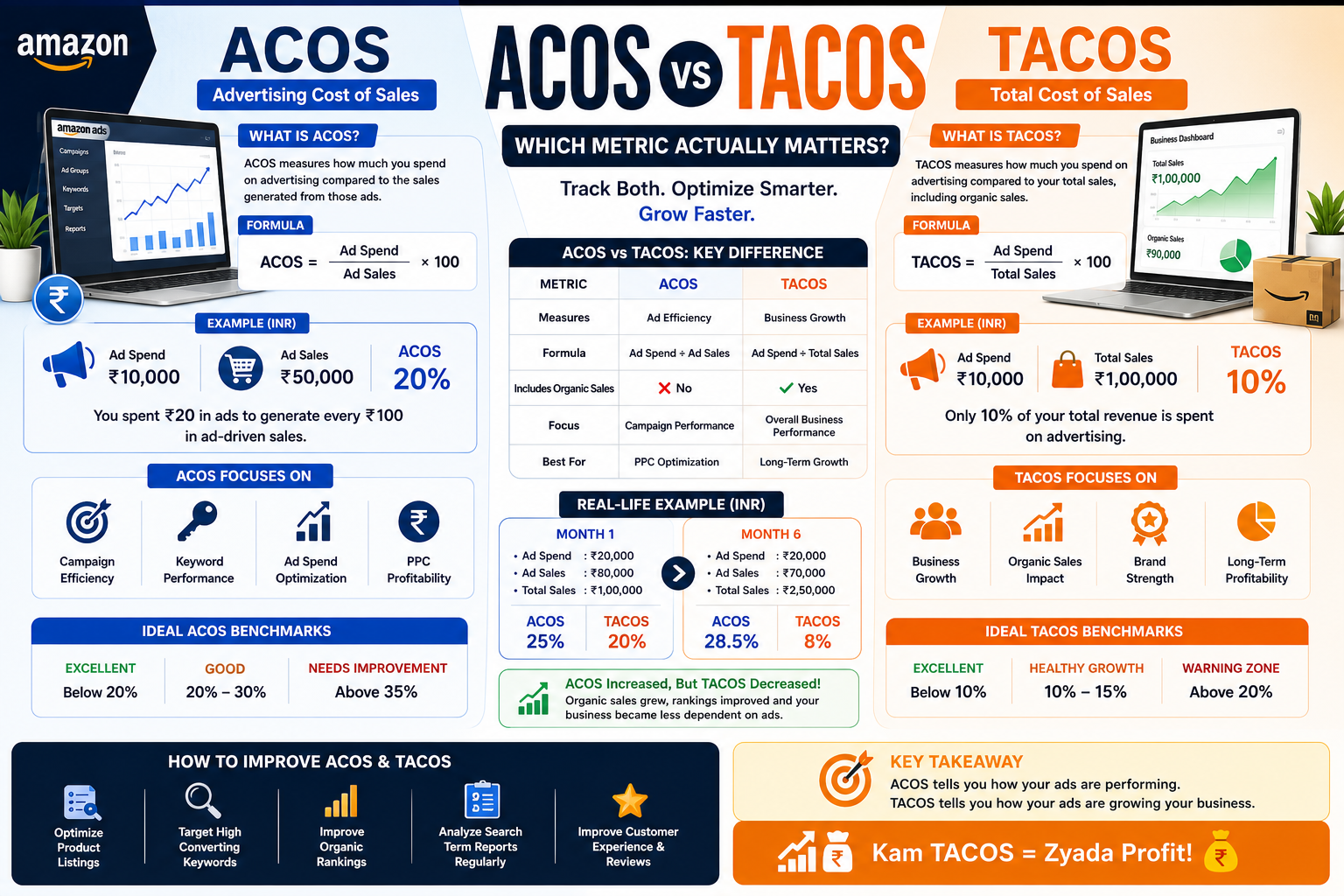
Amazon ACOS vs TACOS: Which Metric Actually Matters?
If you're running Amazon PPC campaigns, you've probably spent countless hours checking your ACOS.
Many sellers celebrate when ACOS goes down and panic when it goes up.
But here's the question:
What if your ACOS looks great, but your business isn't growing?
This is where TACOS enters the picture.
While ACOS helps you understand advertising efficiency, TACOS reveals whether your advertising is actually helping grow your business.
The most successful Amazon brands don't choose between ACOS and TACOS.
They track both.
Let's understand why.
What Is ACOS?
ACOS stands for:
Advertising Cost of Sales
It measures how much money you spend on advertising compared to the sales generated directly from those ads.
ACOS Formula
ACOS = (Ad Spend ÷ Ad Sales) × 100
Example Using Indian Currency
Suppose:
- Ad Spend = ₹10,000
- Ad Sales = ₹50,000
ACOS = 20%
This means you spent ₹20 in advertising to generate every ₹100 in ad-driven sales.
What ACOS Tells You
ACOS focuses on one thing:
Advertising Efficiency
It answers questions like:
- Are my campaigns profitable?
- Are my bids too high?
- Which keywords are wasting money?
- Which campaigns need optimization?
Think of ACOS as a PPC health score.
Benefits of Tracking ACOS
Helps Control Advertising Costs
A lower ACOS generally means you're spending advertising money more efficiently.
Identifies Winning Keywords
ACOS helps you discover which keywords generate profitable sales.
Improves Campaign Performance
By tracking ACOS, sellers can:
- Reduce wasted spend
- Increase conversions
- Improve ROI
Better Budget Allocation
You can move budgets from poor-performing campaigns to profitable ones.
The Problem with ACOS
ACOS only looks at sales directly attributed to ads.
It ignores:
- Organic sales
- Brand awareness
- Repeat customers
- Ranking improvements
- Long-term growth
This means ACOS often tells only half the story.
What Is TACOS?
TACOS stands for:
Total Advertising Cost of Sales
Instead of comparing ad spend against ad sales, TACOS compares ad spend against total business sales.
This includes:
- Ad-generated sales
- Organic sales
- Repeat purchases
TACOS Formula
TACOS = (Ad Spend ÷ Total Sales) × 100
Example Using Indian Currency
Suppose:
- Ad Spend = ₹10,000
- Total Sales = ₹1,00,000
TACOS = 10%
This means only 10% of your total revenue is being spent on advertising.
What TACOS Tells You
TACOS measures:
- Business growth
- Organic ranking impact
- Brand strength
- Long-term profitability
Unlike ACOS, TACOS gives a complete picture of how advertising affects your business.
ACOS vs TACOS: Key Difference
| Metric ACOS TACOS | ||
| Measures | Ad Efficiency | Business Growth |
| Formula | Ad Spend ÷ Ad Sales | Ad Spend ÷ Total Sales |
| Includes Organic Sales | ❌ No | ✅ Yes |
| Focus | Campaign Performance | Overall Business Performance |
| Best For | PPC Optimization | Long-Term Growth |
Real-Life Amazon Seller Example
Let's say you launched a new product.
Month 1
- Ad Spend = ₹20,000
- Ad Sales = ₹80,000
- Total Sales = ₹1,00,000
ACOS = 25%
TACOS = 20%
Month 6
- Ad Spend = ₹20,000
- Ad Sales = ₹70,000
- Total Sales = ₹2,50,000
ACOS = 28.5%
TACOS = 8%
Many sellers would panic because ACOS increased.
But smart sellers would celebrate.
Why?
Because advertising helped improve rankings and organic sales exploded.
Your TACOS dropped from 20% to 8%.
Your business became less dependent on ads.
That's growth.
Why Successful Amazon Brands Watch TACOS Closely
TACOS reveals whether your advertising is creating a lasting impact.
If TACOS decreases over time, it often means:
- Organic rankings are improving
- Brand awareness is increasing
- Repeat purchases are growing
- Advertising is becoming more efficient
This is exactly what sellers should want.
Ideal ACOS Benchmarks
There is no perfect ACOS.
Different categories have different margins.
Generally:
Excellent
Below 20%
Good
20%–30%
Needs Improvement
Above 35%
Ideal TACOS Benchmarks
Excellent
Below 10%
Healthy Growth
10%–15%
Warning Zone
Above 20%
Remember:
A slightly higher ACOS can be acceptable if TACOS is consistently decreasing.
How to Improve ACOS and TACOS Together
Optimize Product Listings
Better listings improve conversion rates.
Focus on:
- Product images
- SEO-friendly titles
- Bullet points
- A+ Content
Eliminate Poor Keywords
Pause keywords that generate clicks but no sales.
Improve Organic Rankings
Better rankings reduce reliance on paid advertising.
Monitor Search Term Reports
Identify high-converting keywords and increase investment in winners.
Increase Customer Satisfaction
Higher ratings improve:
- Conversion rates
- Organic rankings
- Advertising performance
The Metric Most Sellers Ignore
Many sellers obsess over ACOS because it's visible inside Amazon Ads.
But TACOS is often the metric that reveals whether you're building a real business.
A low ACOS with stagnant sales isn't success.
A declining TACOS combined with growing revenue usually is.
The goal isn't just cheaper advertising.
The goal is sustainable growth.
Tools and Solutions for Amazon PPC Growth
Improving ACOS and TACOS starts with improving conversion rates.
Higher conversion rates mean:
- Lower advertising costs
- Better rankings
- More organic sales
AiShots helps Amazon sellers create:
- High-converting product images
- SEO-optimized listings
- Better A+ Content
- Conversion-focused product descriptions
The better your listing performs, the easier it becomes to improve both ACOS and TACOS.
FAQ Section
What is ACOS in Amazon PPC?
ACOS measures advertising spend as a percentage of ad-generated sales.
What is TACOS?
TACOS measures advertising spend as a percentage of total sales, including organic revenue.
Which metric is more important?
Both matter. ACOS measures campaign efficiency while TACOS measures business growth.
Why can ACOS increase while TACOS decreases?
This happens when advertising improves organic rankings and total sales grow faster than ad spend.
What is a good TACOS?
Most successful Amazon brands aim for a TACOS between 5% and 15%, depending on category and growth stage.
Conclusion
ACOS tells you how well your ads are performing.
TACOS tells you how well your business is growing.
Smart Amazon sellers track both metrics together.
Use ACOS to optimize campaigns.
Use TACOS to evaluate long-term growth.
Because the ultimate goal isn't simply reducing ad costs.
It's building a profitable Amazon business that becomes less dependent on advertising over time.