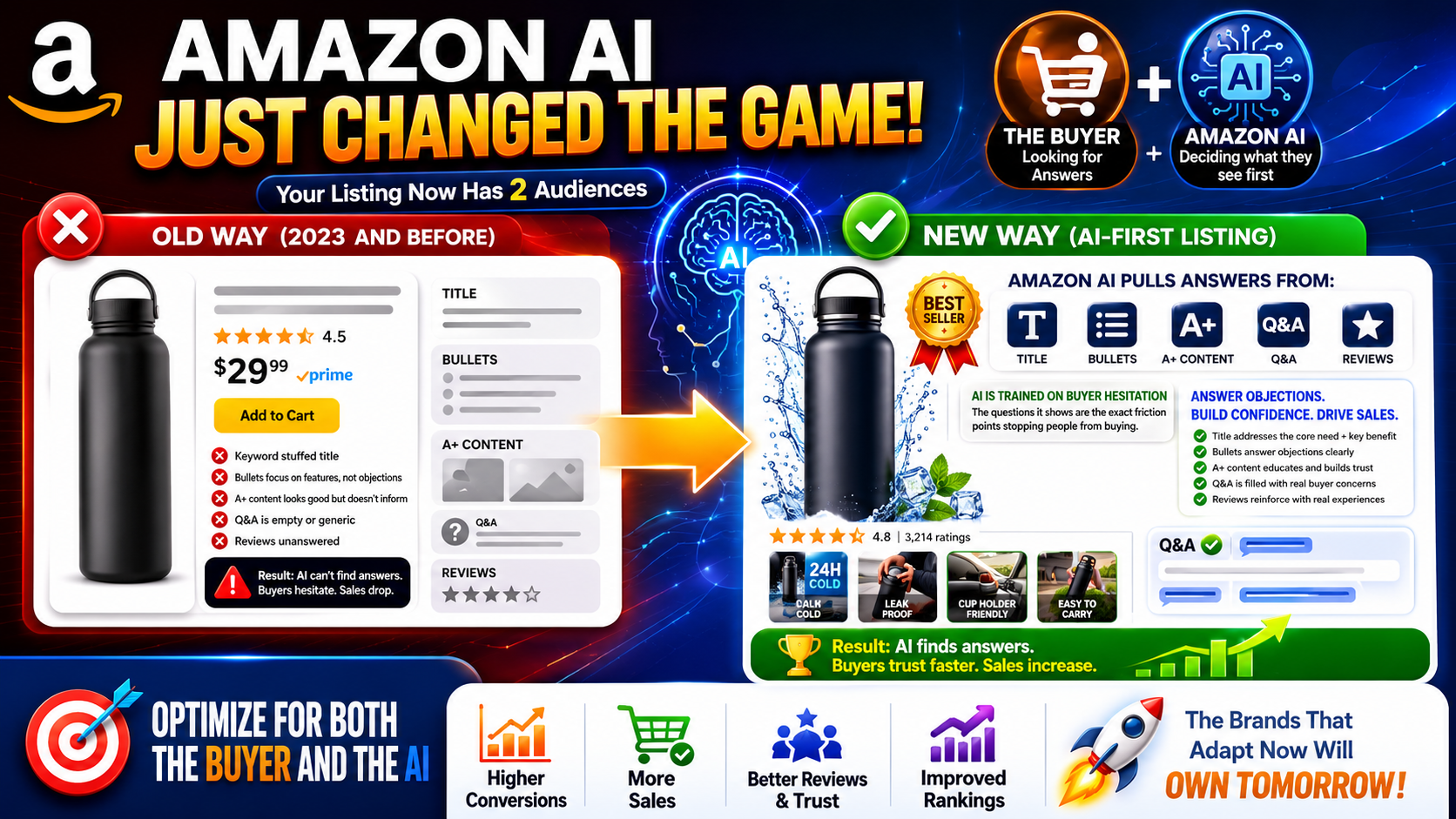
Amazon AI Has Changed the Game: Optimize for Buyers and AI
For years, Amazon sellers optimized listings primarily for human shoppers.
The formula was simple:
- Rank for keywords
- Get clicks
- Increase conversions
But ecommerce is entering a new era.
Today, your Amazon listing has two audiences:
- The buyer looking for answers
- Amazon AI deciding which answers to show
As AI-powered shopping experiences become more prominent across Amazon, sellers must rethink how listings are structured. Winning brands are no longer optimizing only for search visibility—they are optimizing for AI understanding.
If your listing cannot clearly answer customer questions, Amazon AI may struggle to recommend your product.
That means fewer impressions, lower trust, and missed sales opportunities.
Why Amazon AI Changes Everything
Traditional Amazon SEO focused heavily on keywords.
Modern Amazon AI focuses on:
- Customer intent
- Product relevance
- Objection handling
- Contextual understanding
- Trust signals
AI doesn't simply match keywords.
It tries to understand:
- What problem the customer wants solved
- Which product best solves it
- Whether enough evidence exists to support the recommendation
This creates a major shift in how listings should be built.
The Old Way of Amazon Optimization
Before AI-driven shopping experiences became mainstream, many listings relied on:
Keyword Stuffed Titles
Titles were written primarily for rankings.
Example:
"Insulated Stainless Steel Water Bottle Sports Bottle Gym Bottle Leakproof Bottle"
This might rank for keywords but creates a poor customer experience.
Feature-Focused Bullet Points
Many sellers simply listed features:
- Stainless steel
- BPA-free
- Leakproof lid
But customers care more about outcomes.
They ask:
- Will it keep water cold all day?
- Will it fit in my car cup holder?
- Is it suitable for travel?
Generic A+ Content
Many brands treated A+ Content as decoration rather than education.
Beautiful images alone don't answer buying questions.
Empty Q&A Sections
Unanswered questions create uncertainty.
Uncertainty reduces conversions.
How Amazon AI Evaluates Listings
Amazon AI pulls information from multiple parts of your product page.
Product Title
The title helps AI understand:
- Core product category
- Primary use case
- Main customer benefit
Effective titles combine:
- Product type
- Key benefit
- Important differentiator
Bullet Points
Bullet points should answer common objections.
Examples:
Instead of:
"18/8 Stainless Steel"
Write:
"Premium 18/8 stainless steel keeps drinks cold for up to 24 hours and resists rust for long-term durability."
The second version gives AI more context.
A+ Content
A+ Content is no longer just a conversion tool.
It helps Amazon AI understand:
- Product applications
- Use cases
- Comparisons
- Benefits
Well-structured A+ Content can improve both shopper understanding and AI interpretation.
Customer Questions & Answers
Q&A is becoming increasingly valuable.
Why?
Because customers ask the exact questions future buyers want answered.
Examples:
- Is this dishwasher safe?
- Does it fit in a backpack?
- Can kids use it?
These are real-world purchase concerns.
AI uses this information to better match products with shopper intent.
Reviews
Reviews provide authentic customer language.
They reveal:
- Benefits customers value
- Common concerns
- Real-life usage scenarios
This makes reviews one of the richest sources of buyer intent signals.
Common Mistakes Sellers Make in the AI Era
Writing for Algorithms Instead of Humans
Keyword stuffing creates poor readability.
AI increasingly favors clarity and usefulness.
Ignoring Customer Objections
Every product category has common concerns.
If your listing doesn't address them, both customers and AI may lack confidence.
Weak A+ Content
A+ Content should educate.
It should answer:
- Why choose this product?
- Who is it for?
- How is it different?
No Review Strategy
Reviews provide essential trust signals.
Brands that actively improve customer experience naturally generate stronger reviews.
Empty Q&A Sections
An empty Q&A section is a missed opportunity.
It leaves important customer questions unanswered.
Actionable Amazon AI Optimization Strategies
Build Listings Around Customer Questions
Ask:
"What would stop someone from buying?"
Then answer those concerns directly.
Create Benefit-Driven Titles
Don't just describe the product.
Describe the outcome.
Example:
Instead of:
"Yoga Mat 6mm"
Use:
"Extra Thick Yoga Mat for Joint Support and Non-Slip Stability"
Rewrite Bullet Points Around Objections
Every bullet should answer a question.
Examples:
- Will it last?
- Is it easy to use?
- Is it safe?
- Is it worth the price?
Upgrade A+ Content
Include:
- Comparison charts
- Use cases
- Lifestyle imagery
- Problem-solution graphics
- Customer-focused benefits
Strengthen Review Collection
Focus on:
- Product quality
- Packaging
- Customer experience
Better products generate better reviews naturally.
Optimize Q&A Proactively
Identify common questions and provide detailed answers.
This helps both shoppers and AI systems understand your offering.
Tools and Solutions for Amazon AI Optimization
As Amazon continues evolving toward AI-assisted shopping, sellers need smarter content workflows.
Modern optimization tools help brands:
- Generate better product descriptions
- Improve listing structure
- Create high-converting A+ Content
- Optimize customer-facing messaging
AiShots helps ecommerce brands streamline product content creation and listing optimization with AI-powered workflows.
Useful resources:
FAQ Section
What is Amazon AI optimization?
Amazon AI optimization is the process of structuring listings so AI systems can easily understand product benefits, use cases, and customer intent.
Does Amazon AI use reviews?
Yes. Reviews provide valuable context about customer experiences, product performance, and buyer concerns.
Why is A+ Content important for Amazon AI?
A+ Content helps explain product benefits, comparisons, and use cases, making it easier for AI systems to understand your product.
How do I optimize bullet points for Amazon AI?
Focus on answering customer objections and highlighting benefits instead of listing technical specifications alone.
Is keyword stuffing still effective?
No. Clear, customer-focused content performs better than excessive keyword repetition.
Conclusion
Amazon's AI-driven future is already here.
The brands that succeed won't be the ones with the most keywords.
They'll be the ones that provide the clearest answers.
Your title, bullet points, A+ Content, reviews, and Q&A section now work together as a knowledge base that helps both customers and AI understand your product.
Optimize for both audiences:
- The buyer seeking confidence
- The AI seeking relevance
The brands that adapt first will gain a significant competitive advantage in the next generation of Amazon commerce.