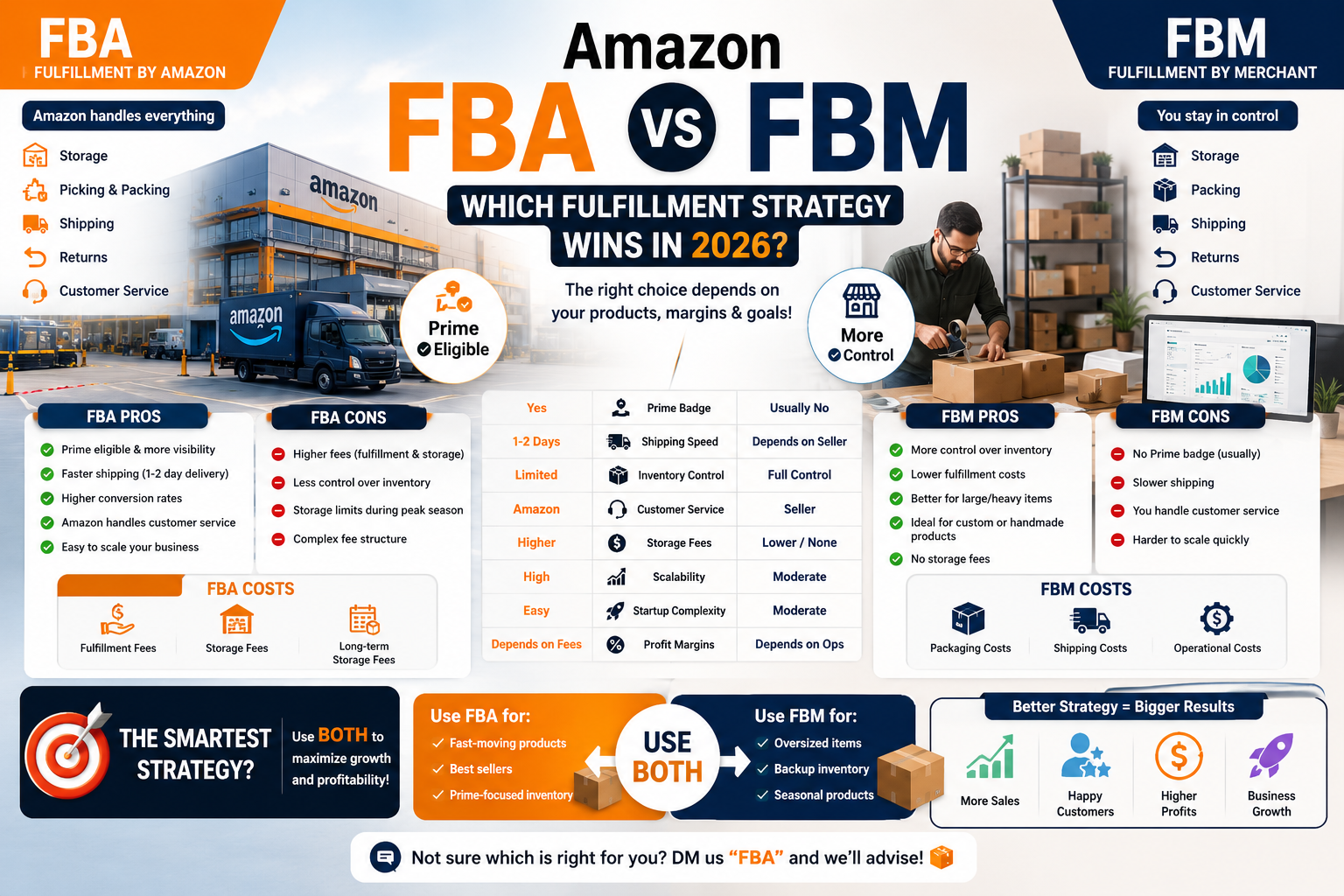
Amazon FBA vs FBM: Which One Should You Choose in 2026?
One of the biggest decisions every Amazon seller faces is choosing between Fulfillment by Amazon (FBA) and Fulfillment by Merchant (FBM).
The choice affects:
- Profit margins
- Customer experience
- Inventory management
- Business scalability
- Operational workload
Many sellers ask:
"Which one is better?"
The reality is that neither model is universally better. The right choice depends on your products, margins, business goals, and operational capabilities.
Let's break it down.
What Is Amazon FBA?
Fulfillment by Amazon (FBA) allows sellers to send inventory to Amazon warehouses.
Amazon handles:
- Storage
- Picking
- Packing
- Shipping
- Returns
- Customer support
Once inventory arrives at Amazon's fulfillment centers, Amazon takes care of the rest.
Benefits of Amazon FBA
Prime Eligibility
Prime customers tend to buy more frequently.
FBA products automatically receive Prime benefits, increasing conversion rates.
Faster Shipping
Amazon's logistics network provides:
- Same-day delivery
- One-day delivery
- Two-day delivery
Fast shipping improves customer satisfaction.
Better Scalability
FBA allows sellers to focus on:
- Product sourcing
- Marketing
- Expansion
instead of daily fulfillment tasks.
Higher Conversion Rates
Customers trust Prime products and Amazon-managed shipping.
Drawbacks of Amazon FBA
Higher Fees
Sellers pay:
- Fulfillment fees
- Storage fees
- Long-term storage fees
These costs can impact profitability.
Less Inventory Control
Your inventory sits inside Amazon warehouses.
Managing stock adjustments can become challenging.
Storage Limitations
Amazon may restrict inventory levels during peak seasons.
What Is Amazon FBM?
Fulfillment by Merchant (FBM) means sellers handle order fulfillment themselves or through a third-party warehouse.
The seller controls:
- Storage
- Packaging
- Shipping
- Customer service
Amazon acts as the marketplace while fulfillment remains under the seller's control.
Benefits of Amazon FBM
More Control
You control:
- Packaging quality
- Shipping methods
- Inventory management
This flexibility is valuable for many brands.
Lower Fulfillment Costs
Products with:
- Large dimensions
- Heavy weight
- Low margins
often perform better under FBM.
Better for Custom Products
Personalized and made-to-order products are often easier to manage through FBM.
Reduced Storage Fees
You avoid Amazon's warehouse storage costs.
Drawbacks of Amazon FBM
Slower Shipping
Unless you have advanced logistics systems, shipping speed may not match Amazon Prime standards.
Increased Workload
You must manage:
- Orders
- Returns
- Customer support
- Inventory
Harder to Scale
Rapid growth can overwhelm fulfillment operations.
FBA vs FBM: Side-by-Side Comparison
| FeatureFBAFBM | ||
| Prime Badge | ✅ Yes | ❌ Usually No |
| Shipping Speed | Excellent | Depends on Seller |
| Inventory Control | Limited | Full Control |
| Customer Service | Amazon Handles | Seller Handles |
| Storage Fees | Higher | Lower |
| Scalability | High | Moderate |
| Startup Complexity | Easy | Moderate |
| Profit Margins | Depends on Fees | Depends on Operations |
Which Sellers Should Choose FBA?
FBA is ideal for:
Private Label Brands
Brands focused on scaling sales quickly.
High-Volume Sellers
Large order volumes benefit from Amazon's fulfillment network.
International Expansion
Amazon's infrastructure simplifies global growth.
Prime-Focused Strategies
If Prime conversions are critical, FBA is often the best option.
Which Sellers Should Choose FBM?
FBM works well for:
Large or Heavy Products
These often incur significant FBA fees.
Low-Margin Products
FBM may provide better profitability.
Handmade & Custom Products
Products requiring customization are easier to fulfill independently.
Established Logistics Operations
Businesses with warehouses and shipping systems may prefer FBM.
The Smartest Strategy: Use Both
Many successful Amazon brands don't choose one.
They use both.
FBA For:
- Fast-moving products
- Best sellers
- Prime-focused inventory
FBM For:
- Oversized items
- Backup inventory
- Seasonal products
This hybrid strategy provides flexibility while reducing risk.
How AI Is Changing Fulfillment Decisions
In 2026, Amazon sellers are increasingly using AI to forecast:
- Inventory demand
- Storage requirements
- Shipping costs
- Profitability
Brands that combine operational efficiency with AI-driven decision-making gain a significant advantage.
Tools and Solutions for Amazon Sellers
Whether you're using FBA, FBM, or both, listing optimization remains critical.
High-converting product content helps maximize every visitor.
AiShots helps Amazon brands create:
- Optimized product listings
- Conversion-focused content
- A+ Content
- Product images
- AI-powered ecommerce assets
Explore:
FAQ Section
Is Amazon FBA better than FBM?
Not always. FBA offers convenience and Prime eligibility, while FBM offers more control and potentially lower costs.
Does FBA increase sales?
In many categories, yes. Prime eligibility and faster delivery often improve conversion rates.
Is FBM more profitable?
For large, heavy, or low-margin products, FBM can be more profitable due to lower fulfillment fees.
Can I use both FBA and FBM?
Yes. Many successful Amazon brands operate a hybrid fulfillment strategy.
Which is better for beginners?
FBA is often easier for beginners because Amazon handles fulfillment and customer service.
Conclusion
The FBA vs FBM debate doesn't have a universal winner.
Choose FBA if your goal is:
- Faster scaling
- Prime visibility
- Operational simplicity
Choose FBM if your goal is:
- More control
- Lower fulfillment costs
- Flexible logistics
For many growing brands, the most profitable approach is a combination of both.
The winning fulfillment strategy isn't about choosing sides—it's about choosing what aligns with your business goals.