Amazon Listing Optimization: How Better Product Images Can Reduce Return Rates
Returns are one of the most expensive hidden costs in ecommerce.
Many sellers focus heavily on increasing conversions, improving rankings, and driving traffic, but overlook a critical metric that directly impacts profitability: return rate.
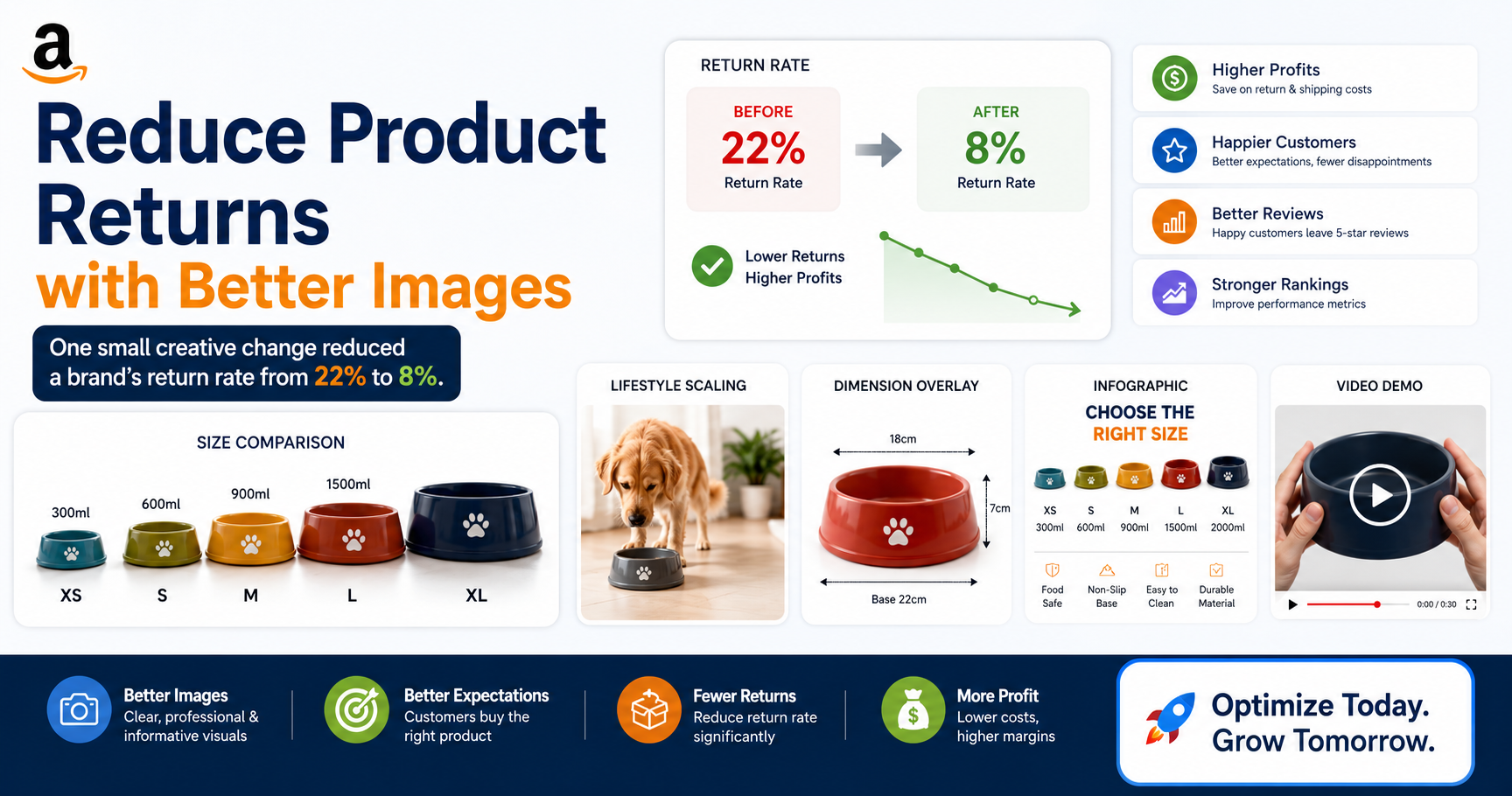
A recent example from the pet products category demonstrates how a simple creative adjustment reduced a product's return rate from 22% to 8%. The change wasn't a redesign of the product, a price adjustment, or a promotional campaign.
It was simply better communication through product images.
This is one of the clearest examples of why Amazon listing optimization is not just about generating more sales—it's about helping customers make better purchasing decisions before they buy.
The Problem: Customers Couldn't Understand Product Size
One of the most common reasons customers return products is that the item doesn't match their expectations.
In the pet bowl example, customers struggled to understand the differences between available size variants.
Although the product dimensions were included in the listing, many shoppers did not take the time to read them carefully.
Instead, they relied on product images to make purchasing decisions.
As a result:
- Customers ordered the wrong size
- Expectations didn't match reality
- Return requests increased
- Negative reviews appeared
- Customer satisfaction declined
This challenge is not limited to pet products.
It affects nearly every ecommerce category:
- Kitchenware
- Furniture
- Home decor
- Apparel
- Fitness equipment
- Electronics accessories
- Storage products
Whenever size, scale, or fit matters, unclear visuals can create costly misunderstandings.
Why Return Rates Matter More Than Most Sellers Realize
Many Amazon sellers evaluate success based on sales volume.
However, high sales combined with high return rates can quietly destroy profitability.
Returns impact:
Revenue
Every returned order reduces net sales.
Advertising Efficiency
You still pay advertising costs for customers who eventually return products.
Operational Costs
Returns increase:
- Shipping expenses
- Processing costs
- Inventory handling
- Customer service workload
Brand Reputation
Frequent returns often lead to:
- Lower review ratings
- More complaints
- Reduced customer trust
Amazon Performance Metrics
Persistent return issues may trigger Amazon investigations or recommendations for listing improvements.
Reducing returns often delivers a greater profit increase than generating additional sales.
Common Amazon Listing Mistakes That Increase Returns
Many sellers unintentionally create return problems through poor listing design.
1. Relying Only on Dimensions
Including measurements such as:
- 15 cm
- 8 inches
- 900 ml
is important.
But numbers alone don't help customers visualize size.
People understand visuals faster than specifications.
2. No Size Comparison Images
Customers need context.
Showing multiple variants side-by-side instantly clarifies differences.
Without comparison images, shoppers guess.
Guessing leads to returns.
3. Missing Lifestyle Photography
Lifestyle images demonstrate how products look in real-world environments.
They help customers answer questions like:
- How large is it?
- How much space does it occupy?
- How does it compare to familiar objects?
Without these visuals, expectations become inaccurate.
4. Poor Mobile Optimization
A significant portion of Amazon traffic comes from mobile devices.
If important sizing information is buried inside text blocks, customers may never see it.
Visual communication becomes even more important on smaller screens.
5. Lack of Video Content
Videos provide dynamic context that static images often cannot.
Customers can immediately understand:
- Product dimensions
- Scale
- Usage scenarios
- Functionality
This reduces uncertainty before purchase.
Best Practices for Using Product Images to Reduce Returns
The most successful Amazon brands treat product images as customer education tools.
Instead of simply showcasing products, they answer potential buyer questions before those questions arise.
Create Variant Comparison Charts
One of the most effective strategies is showing all available sizes together.
For example:
| VariantCapacity | |
| XS | 300 ml |
| S | 600 ml |
| M | 900 ml |
| L | 1500 ml |
Displaying them side-by-side helps customers instantly identify the right option.
Use Lifestyle Scaling Images
Include photos showing products in realistic environments.
Examples:
- Dog bowl beside an actual dog
- Storage container on a shelf
- Water bottle in a person's hand
- Furniture inside a room
These visuals establish scale immediately.
Add Dimension Overlays
Overlay key measurements directly onto images.
Instead of forcing customers to search for specifications, place them where attention naturally goes.
Examples:
- Height
- Width
- Depth
- Capacity
Clear visual labels reduce confusion significantly.
Use Infographic Images
Infographics allow sellers to communicate:
- Features
- Benefits
- Size comparisons
- Usage recommendations
within a single image.
Well-designed infographics improve both conversion rates and customer satisfaction.
Include Demonstration Videos
Video content helps customers see products in action.
Effective product videos can demonstrate:
- True size
- Usage scenarios
- Assembly process
- Product fit
This builds confidence and reduces post-purchase disappointment.
Actionable Strategies for Amazon Sellers
If you want to reduce return rates, perform a listing audit using the following framework.
Step 1: Analyze Return Reasons
Review:
- Customer feedback
- Return comments
- Negative reviews
- Customer support tickets
Look for recurring patterns.
Common examples:
- Too small
- Too large
- Not what I expected
- Different from photos
These signals reveal communication gaps.
Step 2: Identify Missing Visual Information
Ask:
"What information are customers unable to understand before purchase?"
Potential gaps include:
- Scale
- Capacity
- Color accuracy
- Fit
- Installation
Every gap creates friction.
Step 3: Redesign Images Around Customer Questions
Rather than designing images around features, design them around concerns.
Examples:
Customer Question:
"Which size should I buy?"
Image Solution:
A size comparison chart.
Customer Question:
"How big is this?"
Image Solution:
Lifestyle scaling photography.
Customer Question:
"Will this fit my space?"
Image Solution:
Dimension overlay graphics.
Step 4: Test and Measure
Track:
- Return rate
- Conversion rate
- Review sentiment
- Customer feedback
Measure performance before and after image updates.
Small improvements often produce outsized results.
Tools and Solutions for Better Amazon Listing Optimization
Modern ecommerce brands increasingly use AI-powered tools to streamline listing creation and optimization.
Platforms like:
- Product image enhancement tools
- AI content generation systems
- Listing optimization software
- Conversion-focused creative platforms
help sellers produce more effective product content faster.
For brands looking to improve listing performance and optimize product content workflows, AiShots provides tools designed to help ecommerce teams create high-converting assets efficiently.
Explore:
When combined with customer-centric creative strategies, these tools can significantly improve both conversion rates and post-purchase satisfaction.
FAQ Section
How can Amazon product images reduce return rates?
Product images help customers understand size, fit, functionality, and real-world usage before purchasing. Clear expectations reduce dissatisfaction and returns.
What is the most effective image type for reducing returns?
Size comparison images are often the most effective because they eliminate confusion about dimensions and product scale.
Do Amazon videos help reduce product returns?
Yes. Videos show products in use, provide scale references, and answer common customer questions, helping buyers make informed decisions.
Why do customers return products even when dimensions are listed?
Many shoppers do not carefully read specifications. Visual content is processed faster and often influences purchasing decisions more than written details.
Should every Amazon listing include lifestyle images?
In most categories, yes. Lifestyle images provide context and help customers visualize ownership, which improves confidence and reduces expectation mismatches.
Conclusion
The difference between a profitable Amazon business and a struggling one often comes down to customer expectations.
The pet bowl example demonstrates a powerful lesson: reducing returns doesn't always require changing the product itself.
Sometimes, the solution is simply better communication.
By incorporating size comparison graphics, lifestyle photography, visual scaling references, dimension overlays, and product videos, sellers can help customers choose the right product the first time.
The result is a powerful combination of:
- Higher customer satisfaction
- Lower return rates
- Better reviews
- Improved profitability
- Stronger brand trust
The best Amazon listings don't just sell products—they help customers make confident buying decisions.