Amazon SEO vs Amazon PPC: Which One Should Sellers Focus On?
One of the most common questions Amazon sellers ask is:
"Should I invest in Amazon SEO or Amazon PPC?"
The answer is simple:
You need both—but for different reasons.
Many sellers treat Amazon SEO and Amazon PPC as competing strategies. In reality, they work together to drive visibility, traffic, and sales.
Think of it this way:
- Amazon SEO is like building a house.
- Amazon PPC is like turning on the lights.
Without SEO, your product struggles to rank organically.
Without PPC, growth can be slow and competitors may dominate valuable search placements.
Understanding the difference between the two can help sellers allocate budgets more effectively and build a long-term growth strategy.
What Is Amazon SEO?
Amazon SEO (Search Engine Optimization) is the process of optimizing your product listing to rank organically in Amazon search results.
The goal is simple:
Improve visibility without paying for every click.
Amazon SEO involves optimizing:
- Product title
- Bullet points
- Product description
- Backend keywords
- A+ Content
- Images
- Reviews
- Conversion rates
When done correctly, Amazon rewards your product with higher rankings for relevant keywords.
How Amazon SEO Works
Amazon's algorithm wants to show products that are:
- Relevant
- High-converting
- Well-reviewed
- Frequently purchased
The better your listing performs, the more organic visibility you receive.
For example:
If someone searches for "stainless steel water bottle" and your product consistently gets clicks and sales, Amazon is more likely to rank it higher.
Benefits of Amazon SEO
Free Long-Term Traffic
Unlike advertising, organic rankings continue generating traffic even when you're not spending money.
Higher Profit Margins
Since you're not paying for every visitor, your profit margins improve over time.
Sustainable Growth
Strong SEO creates long-term brand visibility and market authority.
Better Customer Trust
Many shoppers trust organic results more than sponsored products.
Challenges of Amazon SEO
SEO is powerful, but it isn't instant.
Common challenges include:
- Ranking takes time
- Competition is high
- Requires ongoing optimization
- Difficult for new products
SEO is a long-term investment.
What Is Amazon PPC?
Amazon PPC (Pay-Per-Click) is Amazon's advertising platform that allows sellers to pay for visibility.
With PPC, your product appears in sponsored placements across Amazon search results.
You pay only when a shopper clicks your ad.
How Amazon PPC Works
You bid on keywords.
For example:
If you sell a water bottle, you might bid on:
- Water bottle
- Stainless steel bottle
- Insulated water bottle
When shoppers search those terms, Amazon may display your product.
If they click, you're charged.
Benefits of Amazon PPC
Instant Visibility
Unlike SEO, PPC can put your product in front of customers immediately.
Faster Product Launches
New products often struggle to gain traction organically.
PPC accelerates visibility and sales.
Keyword Data
Advertising campaigns reveal which keywords generate sales.
This information can improve your SEO strategy.
Sales Growth
Well-managed campaigns can scale sales rapidly.
Challenges of Amazon PPC
Advertising Costs
Every click costs money.
Poorly optimized campaigns can become expensive.
Budget Waste
Targeting irrelevant keywords can drain advertising budgets.
Continuous Monitoring Required
PPC campaigns require:
- Bid adjustments
- Search term analysis
- Budget management
- Conversion tracking
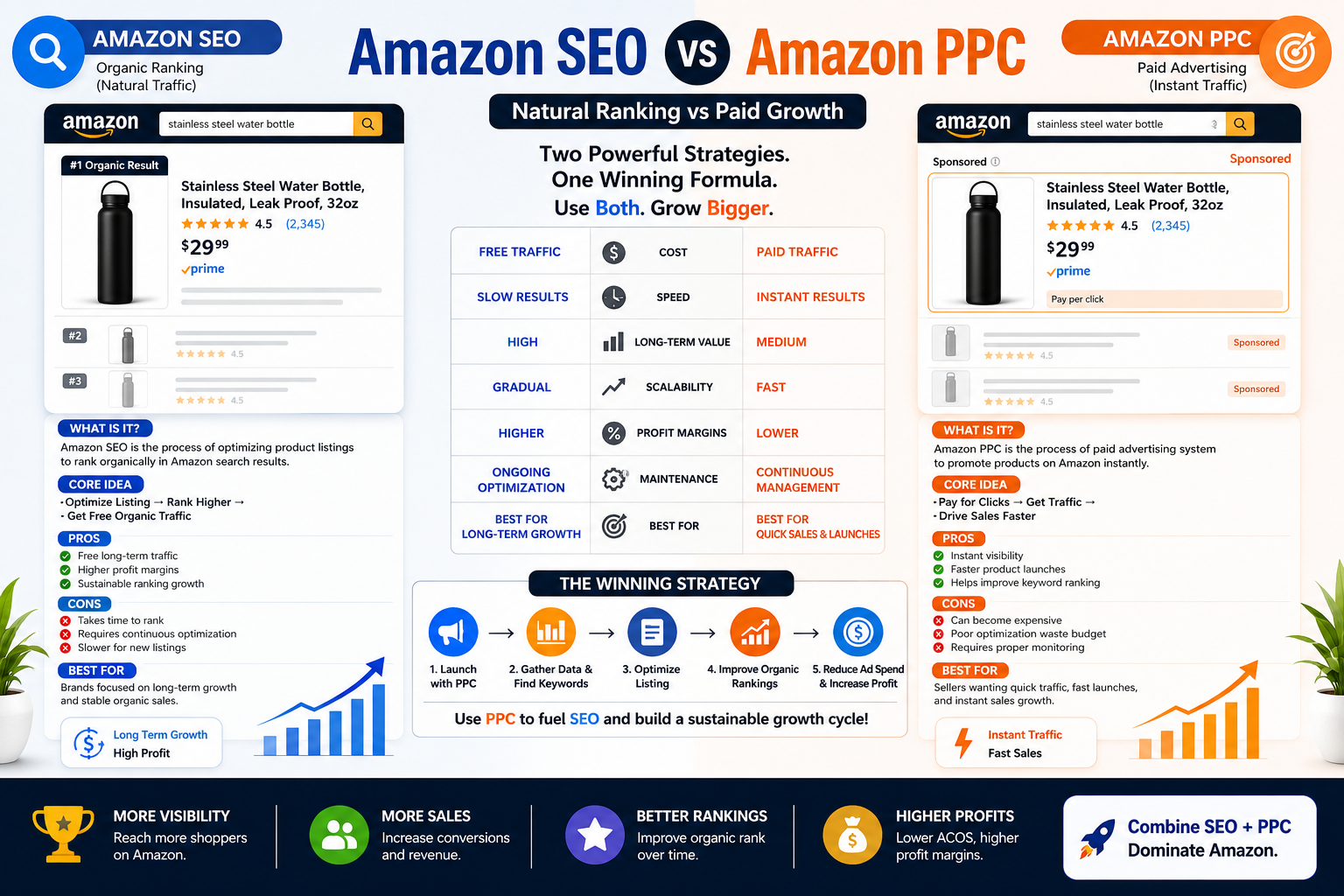
Amazon SEO vs Amazon PPC: Side-by-Side Comparison
| FactorAmazon SEOAmazon PPC | ||
| Cost | Free Traffic | Paid Traffic |
| Speed | Slow Results | Instant Results |
| Long-Term Value | High | Medium |
| Scalability | Gradual | Fast |
| Profit Margins | Higher | Lower |
| Maintenance | Ongoing Optimization | Continuous Management |
| Best For | Long-Term Growth | Immediate Sales |
The Biggest Mistake Sellers Make
Many sellers choose one strategy and ignore the other.
Examples:
SEO Only
You save on ad spend but growth becomes slow.
PPC Only
You generate sales but become dependent on advertising.
The most successful Amazon brands use PPC to accelerate SEO.
The Winning Strategy: Use PPC to Fuel SEO
Top sellers follow this approach:
Step 1: Launch with PPC
Generate initial traffic and sales.
Step 2: Gather Conversion Data
Identify winning keywords.
Step 3: Optimize Listing
Update titles, bullets, and backend keywords.
Step 4: Improve Organic Rankings
Sales generated through PPC help strengthen organic performance.
Step 5: Reduce Advertising Dependency
As organic rankings improve, profitability increases.
This creates a sustainable growth cycle.
Tools and Solutions for Amazon Growth
Managing both SEO and PPC can become overwhelming as product catalogs grow.
Successful brands use AI-powered tools to streamline:
- Listing optimization
- Keyword research
- Product image creation
- A+ Content development
- Conversion-focused content
AiShots helps ecommerce brands create optimized product content designed to improve both organic rankings and conversion rates.
Useful resources:
FAQ Section
Is Amazon SEO better than Amazon PPC?
Neither is better. SEO provides long-term growth, while PPC delivers immediate visibility.
Can I rank on Amazon without PPC?
Yes, but growth is usually slower, especially in competitive categories.
Does PPC improve organic rankings?
Indirectly, yes. More sales and conversions can improve Amazon's perception of listing relevance.
How much should beginners spend on Amazon PPC?
The budget depends on competition and product category, but sellers should start with controlled testing and optimization.
Should new products use PPC?
Absolutely. PPC helps generate the initial traffic and sales needed to build ranking momentum.
Conclusion
Amazon SEO and Amazon PPC are not competitors.
They are partners.
SEO builds long-term organic traffic and stronger profit margins.
PPC delivers immediate visibility, faster launches, and valuable keyword insights.
The smartest sellers don't choose one over the other.
They use PPC to accelerate growth while building a strong SEO foundation that generates sustainable sales for years to come.